 DipGrid
Stop Order vs. Limit Order: Which One Buys the Dip?
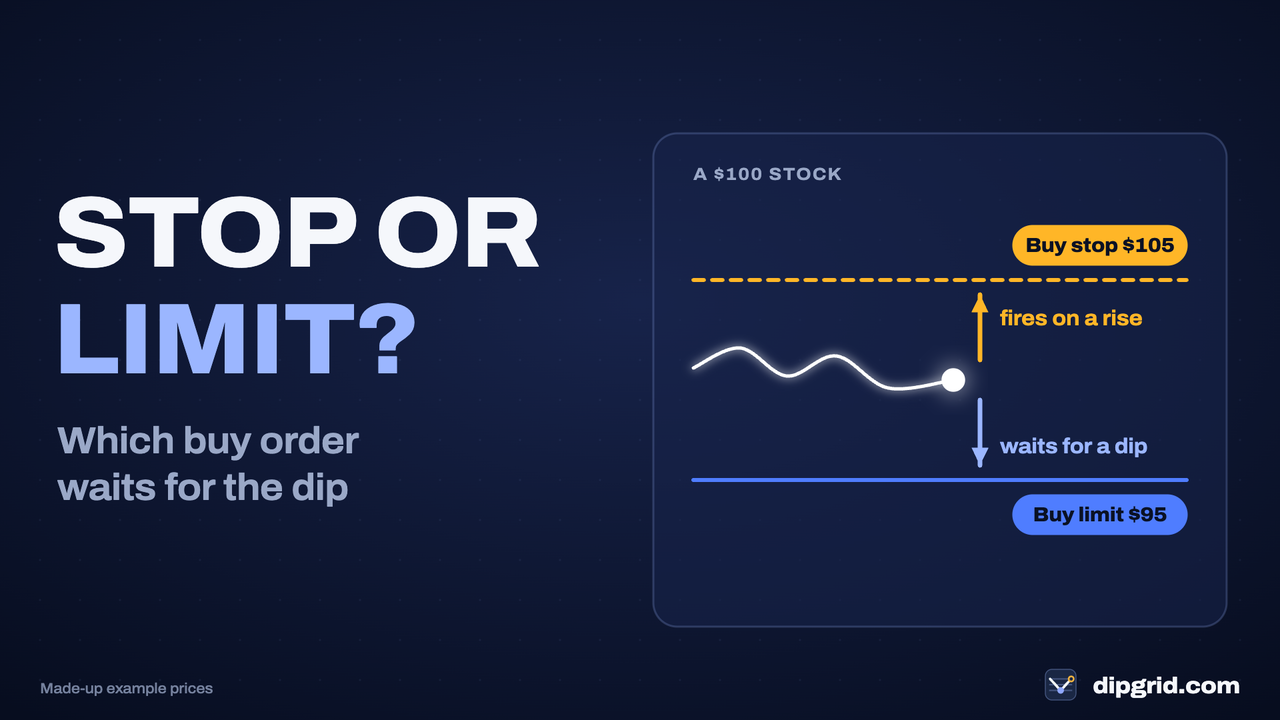
A stock sits at $100 and you think it may fall. You'd happily buy it at $95. You open the order screen and see market, limit, stop and stop-limit. Four choices, and the names don't say which one waits for a dip.
Every price below is made up.
Key takeaways
- A buy limit sits below the price and buys at your price or better. It's the order that waits for a dip.
- A buy stop sits above the price. It fires when the stock rises to it, so it is made for breakouts, not dips.
- On a gap down, a buy limit fills at or near the opening price, below the price you set.
What a buy limit does
A limit order has one rule: your price or better. For a buy, better means lower.
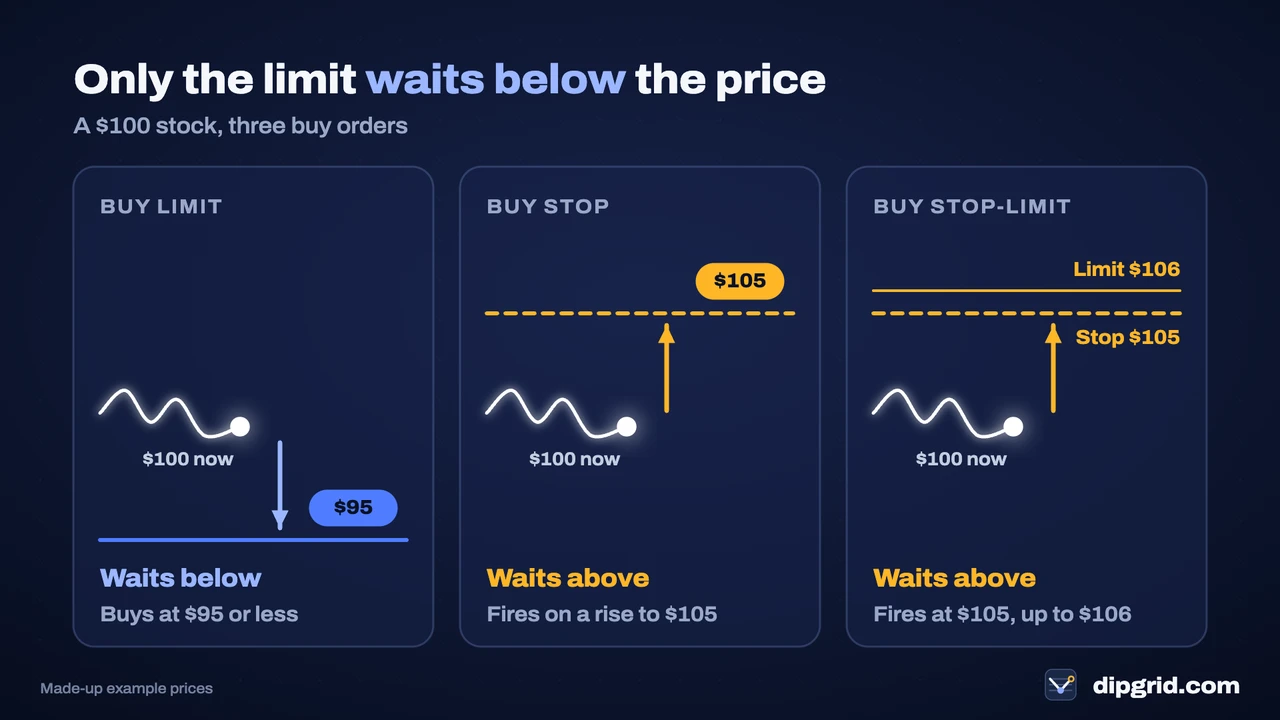
Say the stock trades at $100 and you place a buy limit for 100 shares at $95. Nothing happens while the price stays above $95. When it falls to $95, the order fills at $95 or less. You pay $9,500 at most.
The catch is that it may never fill. If the stock bottoms at $95.20 and turns, you own nothing. Sometimes it touches your level and still doesn't fill, because other orders at that price were ahead of yours.
Also check how long the order stays open. A day order expires at the close. A good-till-canceled order stays until you pull it. Brokers differ on the details.
What a buy stop does
A stop order waits for a trigger price. Once the stock trades at that price, the order turns into a market order and fills at whatever price is available.
For a buy, the trigger sits above the current price. Put a buy stop at $105 on our $100 stock. Nothing happens while it stays under $105. If it climbs to $105, your order fires and fills close to $105, maybe a bit higher.
So a buy stop says "buy it once it proves it's going up". Some people use it to catch a breakout. That's a fine plan, and it's the opposite of buying a dip.
Put a buy stop below the price and it makes no sense. Depending on the broker, it is refused or sent at once. Either way it doesn't wait for a drop.
What a buy stop-limit does
A stop-limit has two prices. The stop is the trigger. The limit is the most you'll pay once it fires.
Take a stop of $105 and a limit of $106. The stock rises to $105 and the order becomes a buy limit at $106. If the stock jumps straight to $108, your limit is already behind it and the order may not fill at all.
It's still an order that waits for a rise. The trigger is above the market, so it doesn't buy a dip either.
Where the confusion comes from
Most people meet the word stop through the stop-loss. A sell stop sits below the price and fires when the stock falls. So "stop" feels like the order for falling prices.
It is, but it sells. A buy stop works the other way round: it fires when the price rises.
There's one buy stop that does follow a drop: the trailing buy stop. It moves down with the price and fires once the stock bounces a set amount off its low. So it buys after the dip has turned, at a price you don't know in advance.
What happens on a gap down
Stocks don't always move in small steps. Bad news arrives overnight and the stock opens far from yesterday's close. That jump is a gap.
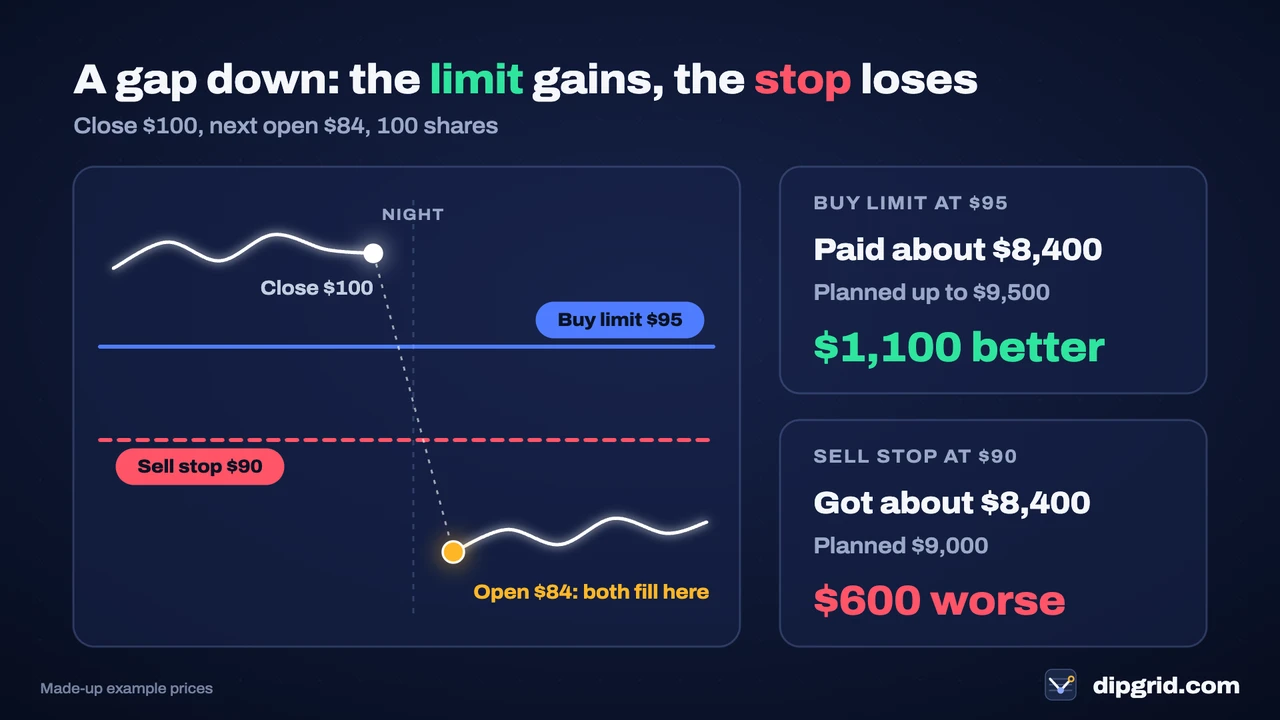
Say the stock closes at $100 and opens the next morning at $84.
With a buy limit for 100 shares at $95, the order is already above the market at the open, so it fills at or near the opening price, around $84. You pay about $8,400 instead of the $9,500 the limit allowed, $1,100 less than planned.
Now take 100 shares you hold with a sell stop at $90. The price jumped past $90, so the stop fires, becomes a market order and fills around $84. You get $8,400 for shares you planned to sell at $90 for $9,000, which is $600 worse than your level.
A limit sets the most you'll pay. A stop only sets a trigger, and the market decides the price after it.
What to use to buy the dip
The buy limit. It waits below the price and never pays more than you said.
You can also put several in a row, say three limits of 100 shares each at $98, $96 and $94. If the stock falls to $95, the first two fill. That's 100 × $98 plus 100 × $96, which is $19,400. The third waits for $94. Each open buy holds cash until it fills or you cancel it, so the whole row needs money set aside.
How far apart to space the levels is its own question, and there's a guide for it.
A bot can keep the row of limits
One limit order is easy. A row of them, plus a sale for every share that fills, takes attention every day the stock moves.
A grid bot on DipGrid does this. You pick the stock, the first buy, the step between levels and the shares per level. It places buy limits on levels below the price. When one fills, it puts those shares up for sale one step higher, and when they sell, the level goes back to work. It runs on our server and trades in your own brokerage account, so your computer doesn't need to be on.
This bot and others are on dipgrid.com, from $29. You can watch one work on made-up prices there, no sign-up.
Questions people ask
Is a stop order or a limit order better for buying a dip?
A limit order. A buy limit waits below the price and fills at your price or better. A buy stop sits above the price and fires when it rises.
What is the difference between a buy stop and a buy limit?
A buy limit is placed below the market and fills when the price falls to it. A buy stop is placed above the market and fires when the price rises to it, then fills as a market order.
Can I use a buy stop to buy when the price drops?
Not in the dip itself. A regular buy stop fires on a rise. A trailing buy stop follows the price down and fires on the bounce, so it buys after the low, at a price you can't set ahead of time.
What happens to a buy limit if the stock gaps down below it?
It fills at or near the open. If your limit was $95 and the stock opens at $84, you pay about $84.
Does a buy limit guarantee I get the shares?
It guarantees the price, not the fill. If the stock never reaches your level, or touches it while others are ahead of you, the order can stay unfilled.
How long does a limit order stay open?
It depends on the duration you pick. A day order expires at the close. A good-till-canceled order stays until it fills or you cancel it. Brokers set the details.